

Thakur · 7 of 7
Why Him, and Why Now
Our reading. We believe Thakur Anukulchandra is needed today more than ever before. Not because he was holy and others were not, but because the questions of our time are the ones his life answered, in practice and in his own words: how to trust a teacher, how to live with an anxious mind, how to hold science and faith together, how to live beside people of other faiths, how to keep a life whole. This page says why, and what we are doing about it.
Why he matters now
In an age that has learned to distrust gurus, he distrusted the role himself. At the threshold of Satyanusaran he wrote, to anyone who would follow him for name or riches, “Don’t make me your Lord and Master.” He said, “Of praise I know nothing.” He did not want worship that kept him at a distance: “Calling me Thakur becomes meaningful only when you rouse the Thakur within you.” And of wonders: “Those who depend on miracle have ignorance for their foundation; they cannot go far.”
In an age of anxious minds, he spoke of the mind with a doctor’s care. He was a physician first, who took no fee. He taught that the mind’s complexes are to be adjusted, not suppressed, by binding them to one love; and that meditation is staying with the one you love while feeling every distraction without being carried off by it. “Be keen but calm,” he said.
In an age when science and faith are set against each other, he saw them as one search. “The scientist is the rishi of this age.” When his workers did not yet get two meals a day, he asked them to raise money for a science laboratory, and he begged for its instruments one by one.
In an age of division between faiths, he held every great teacher in reverence. He called Ram, Krishna, Jesus and Hazrat Rasul his forerunning teachers, and asked nobody to change their religion. In a flood, he once said, “tiger, bear, monkey, snake, and man will all climb the selfsame tree,” and then asked: “what, then, are Hindu, Muslim, Buddhist, Christian?”
In an age when life is broken into pieces, work here, family there, health and faith somewhere else, he taught dharma: whatever upholds one’s own life and growth along with that of others. His sayings run to thousands, on the care of children, health, marriage, farming, education, the economy and the State, because for him a human life is one whole.
In an age that answers harm with harm, he kept close the men who plotted his death, and when a crowd attacked his ashram he refused to give the police their names. “Can a man be changed by bodily punishment? My discipline is of forgiveness, of love.”
In an age of dependence, he showed a village how to stand on its own: a school, a press, workshops, a power-house and a Chemical Works, built by people who drew no salary. And when he lost all of it, he began again with nothing: “People say, ‘What a great loss!’, but it does not touch me. But man is very precious to me.”
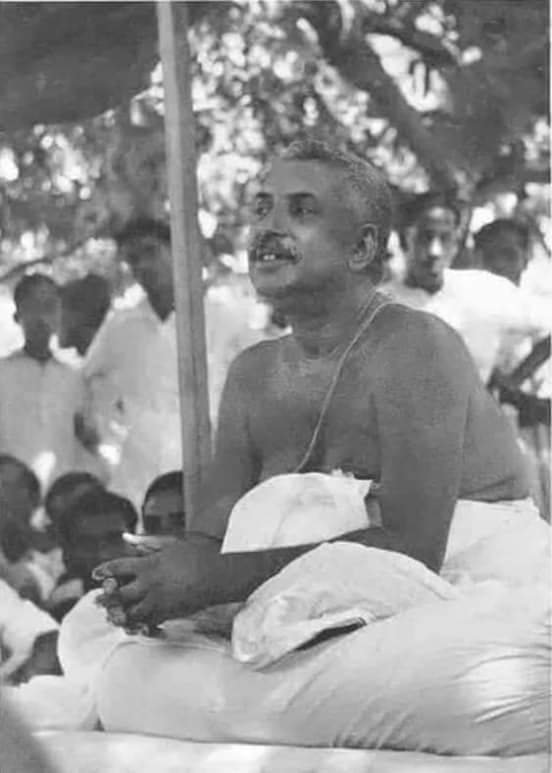
As he is
How is he to be carried to people now? As he is. Not polished into a saint of plaster, not softened where his words are hard, not dressed in claims he never made. His own words, as he spoke them; his own life, as those who stood beside him saw it. He gave the measure for this himself, and he gave it to everyone.
His own warning, given to everyone
One night at Himaitpur, a young man with no degree, no post and no name filled a notebook for a friend who was going away. That notebook became Satyanusaran. At its threshold, before the first section, he set these lines. In the English read out and approved in his presence, they run:
Oh, you who would devotees be with hope for name and riches, Don’t make me your Lord and Master,
Beware! If mastery within Awakens not,-
Master, Centre- none you have, and deceiving, you shall be deceived.Satyanusaran, the English approved in his presence (1950) · the first of the three messages printed before §1
The Bengali word behind “mastery within” is ঠাকুরত্ব, the Thakur in a person, which must wake. Unless it wakes, nobody is your centre and nobody is your master, however loudly you call him so.
He did not exempt his own people. In the young days of the Satsang at Himaitpur, he said of it:
Perhaps Satsang too has become, or may yet become, like the other sects. If ever — whenever — the followers or admirers of Satsang, in trying to establish themselves, go against what I have said or am saying, and lose the service of the Gurus who came before, then it is certain that it will be nothing but a narrow enclosure.
Nānā-Prasaṅge, vol. 1, last page · Translated by Souvik Ghosh [d]
Yet he did not fear many groups. He feared a forgotten centre.
Even if there are a hundred thousand groups, nothing is lost, if the Lord of the groups is One. Then, through every succession and in every fulfilling, the peg stays where it is — and that is the one remedy against breaking apart.
Śāśvatī, vol. 1, saying 251, as given in Brajagopal Duttaray, Sree Sree Thakur Anukulchandra, vol. 3, ch. 9, p. 293 · Translated by Souvik Ghosh [d]
It is not a curse, and it is not a judgement on anyone. It is what a father says at the door when his children set out on a road he knows well. The test inside it falls on every company alike. Not which of us is right, but whether we are keeping what he said, as he said it; whether we still honour the Gurus who came before him, as he honoured them; and whether, in all our building, it is he who is being established, or we. Hold every company that carries his name to that test, and hold Master Within to it too.
Many companies, one Master
When a Living Ideal leaves the body, those who loved him do not stay in one house for long. After Jesus, the apostles went out by different roads to different peoples. Yet they were many men with one Master, and the work of every one of them was to turn people towards him, not towards themselves. So it has been after every Prophet.
How we work
The test is easy to state and hard to keep. This is how we try to keep it.
His words come first. Every saying we give as his is quoted from his own text, with the book and the place in it, as on this page. Where the English is his own, in The Message and Magna Dicta, or was approved in his presence, as with the 1950 Satyanusaran, it is kept exactly as printed. Where the English is our translation from his Bengali, the source line says so.
Primary sources only. We work from Brajagopal Duttaray’s three-volume biography, his own recorded reminiscences, the dated books of his discourses (Kathā-Prasaṅga, Nānā-Prasaṅge, Alochona-Prasaṅge) and the memoirs of those who were there. Compilations and later commentaries are maps. They help us find a passage. They are never quoted as his words.
One example of the checking. A passage often quoted as his runs as a chain of short lines: from existence and becoming, through dharma and the living Ideal, to the adjustment of the complexes and on to samadhi. Because it is loved, we went looking for it: through all nine volumes of The Message, the whole of Magna Dicta, the 1950 English of Satyanusaran, the English renderings of Kathā-Prasaṅga and Nānā-Prasaṅge, and their typed Bengali. Neither the passage nor any one of its sentences was there. Even its key phrase, “blissful becoming”, is his own English, in a prayer in The Message; the passage itself is not. Some of his books, the largest record of his discourses among them, are still with us only as page images, waiting to be read through. Until the passage is found in his own text, we do not quote it as his. Its ideas he did put in his own words, and those we quote:
What makes anything stand on
with life and growth
is Dharma.The Message, vol. II, “Dharma—for life and growth” · his own English
He is the existence of all that exists, thereby He, the Sat ; He is the responsiveness of all that respond, so Chit—that He is ; He is the becoming of each that becomes, thus He, the Ananda …
Magna Dicta, 75 · his own English
Nothing softened, nothing added. His hard teachings stay in his words and in their setting. Extraordinary events are told as those present saw them, with his own response, and nothing more is claimed. The Holy Name and the method of initiation are never printed.
The work behind it. This is the method of Souvik Ghosh’s two books, both in preparation and both built from these sources: The Living Ideal, the full life in English, and The Way of the Living Ideal, his whole teaching, every saying located. A third strand, Satyanusaran Decoded, also in preparation, reads the little notebook section by section.
A reader can check us. How we use his words sets out the rule. Anyone may ask us for the source of any line through Ask a question. Where a line has not yet been checked against print, we will say so.
Not a sect, but an answer
Master Within adds no new doctrine and no new head. Those who work in it follow Thakur Anukulchandra himself, in the Satsang he founded, and, as he asked on that same threshold page, take as their own all who love him.
Oh Mankind! if you desire to invoke your good, forget sectarian conflict. Be regardful to all the past Prophets. Be attached to your living Master or God and take only those who love Him as your own.
Satyanusaran, the English approved in his presence (1950) · the third of the three messages printed before §1
What we are doing about it
One mission, two hands. Master Within carries the inner life: his words, kept as he gave them, and a way to live them every day. Vishwa Vigyan carries the science and the building he dreamed of. Both are small, both are young, and both are free to walk into.
Master Within
Master Within is a spiritual, educational and social-welfare foundation, begun in 2016: in its own words, “a mission for the total wellbeing and harmonious growth of individuals, families and society”. It holds that health, mind, character, relationships, work, family, society, nature and spiritual realisation belong to one whole, and it looks for the roots of our difficulties with his life and teachings as its guide. What it does now:
- Reads his words together. Living Wisdom, a weekly class every Friday at 16:30 UTC, in Bengali and Hindi: his words read aloud, then conversation. You can just listen.
- Writes, from real questions. Short readings and explainers in the Wisdom library, each starting from a question people actually ask, and the newsletter.
- Helps people sit. A guided meditation of five to ten minutes, free, on the home page; and Sadhana, a small daily-practice app, in the making.
- Listens. Want to talk to someone? A person from Master Within reads every message, with no conditions.
- Keeps a home. Naihati Charyashram, our centre, in the railway town on the Hooghly where he once finished his schooling.
- Writes the books. The Living Ideal, his full life in English, and The Way of the Living Ideal, his whole teaching with every saying located, both by Souvik Ghosh and both in preparation; and Satyanusaran Decoded, a section-by-section study.
Everything here is free. Nobody is asked to join anything, pay anything or change their religion.
Vishwa Vigyan
When the Satsang had not a paisa to its name, and its workers did not yet get two meals a day, he said to one of the brothers, laughing, “Try to raise funds for founding a science laboratory here.” Many took it for a jest. It was the most intense longing of his heart. Begging for the money, he gathered instrument after instrument: a projection microscope, an X-ray apparatus, a spectroscope, a galvanometer and more. A two-storeyed building rose by the ashram, with rooms for physics, chemistry, botany and psychology and a library of science above them: the Vishwa Vigyan Kendra, the World Science Centre. “The Vishwavijnan is the thing dearest to my heart of all things,” he would say.
Science seems to be leading man toward unity, in a vast plan — melting all the manyness and leading toward the One. The scientist is the rishi of this age.
Brajagopal Duttaray, Sree Sree Thakur Anukulchandra, vol. 2, ch. 2, entry 38, pp. 66–67 · Translated by Souvik Ghosh
Then the storm years came, and he left Himaitpur with almost nothing in his hands. The press, the workshop, the Chemical Works, the school and the Vishwa Vigyan Kendra stayed in their places. In time the men who had grown old at those machines left every tool where it lay and, weeping silently, walked out of the ashram. The house of science by the Padma was left a dream begun and not finished.
Vishwa Vigyan takes up that unfinished dream. It names itself after the Satsang Vishwa Vigyan Kendra, as the initiative that means to bring his dream of it, in time, to its fullness. It calls itself “a small group of researchers and builders, started by physicist Souvik Ghosh as an initiative of Master Within”, and it labels every piece of work for what it is:
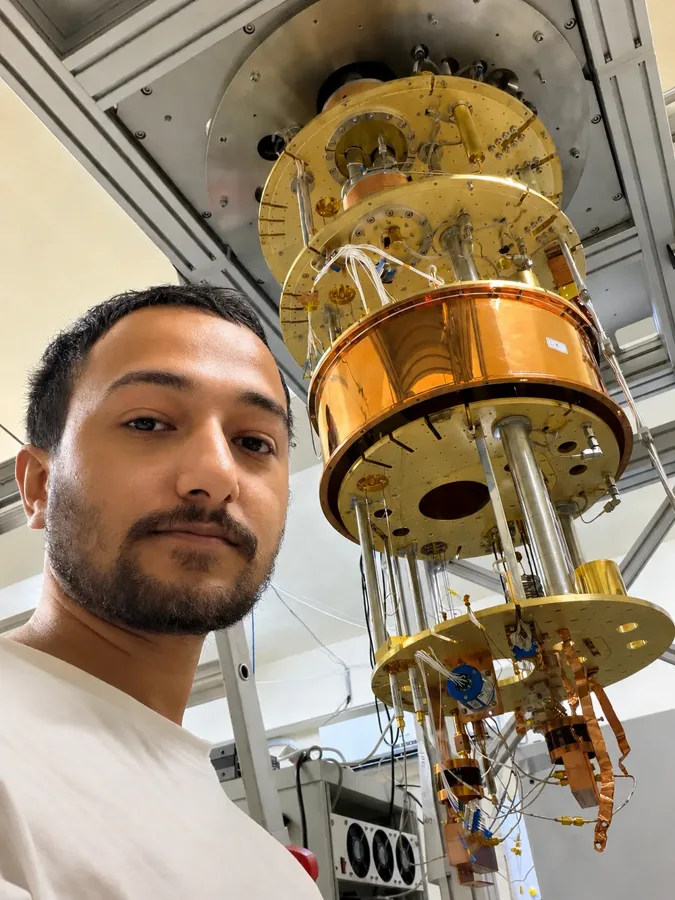
- Quantum Time Lab, with Prof. P. Singha Deo’s Mesoscopic Time Group: published and ongoing. It asks whether a signal can arrive before it is sent; the site says plainly that direct experimental tests of the group’s reading remain open.
- Quantum AI: hands-on and ongoing. Superconducting qubits beside AI systems.
- Non-Hermitian systems: two preprints, one manuscript in development.
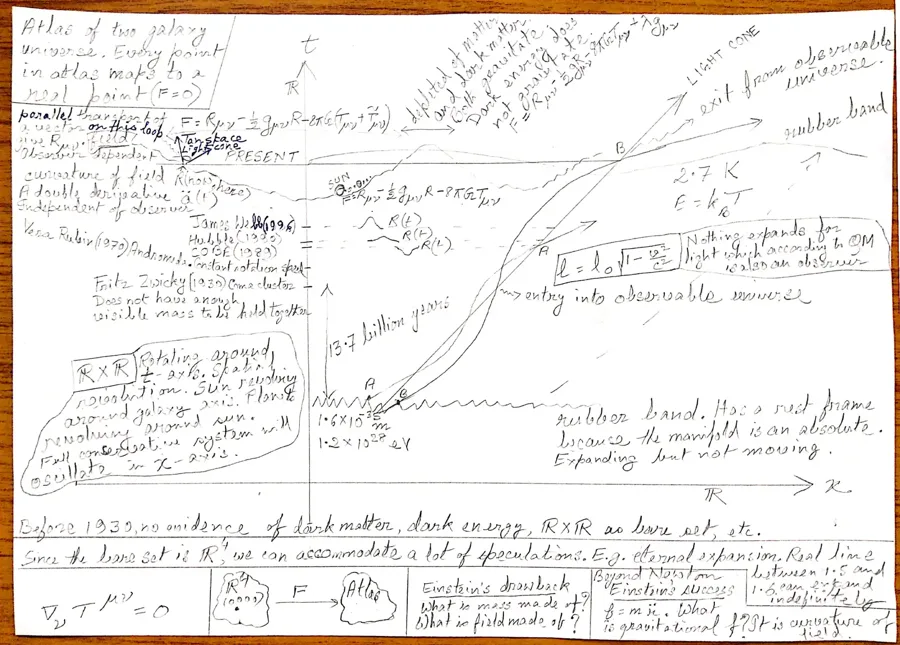
- Big Bang Atlas, with Prof. P. Singha Deo: exploration, early stage.
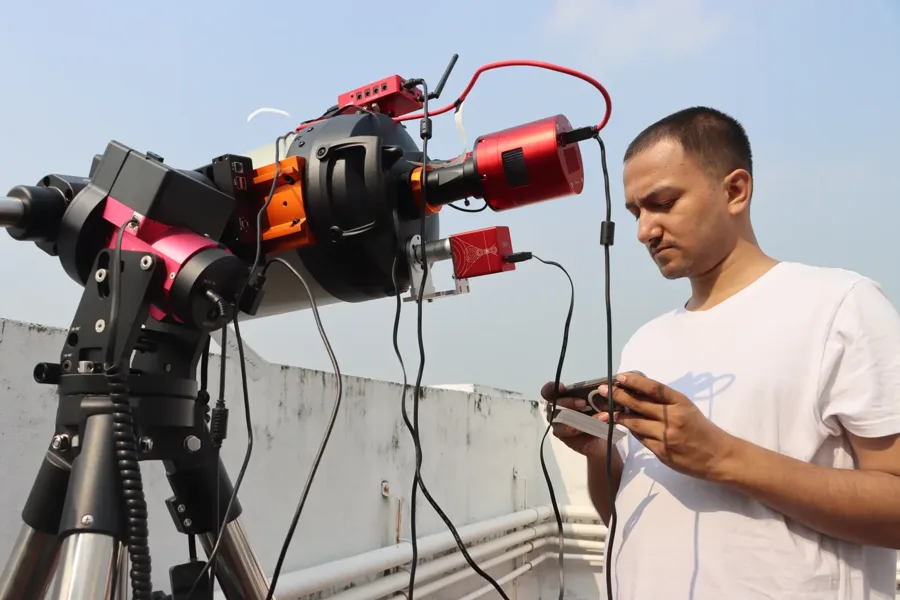
- Purākaash Mk II: completed. A deep-sky telescope built for bright city skies.
- Consciousness, Project Sat-Chit-Ananda: research book, version 0.2. It rebuilds his account of consciousness from his recorded words and sets out six claims about practice that a laboratory could test. The studies are designed and not yet run.
Its own then and now sets the Himaitpur workshop and press beside VV Automate and VV Research Desk, working systems for small businesses and researchers, and the Tapovan school beside free guidance for students who want to build things themselves.
They are not two missions but one, with two hands. One turns the heart towards the Ideal. The other turns that love into knowledge, instruments and work that serve the world.
Come and walk with us
You do not need to belong to any group to begin. These are the ways in.
- Read with us. Living Wisdom, a weekly reading of his words and conversation, every Friday at 16:30 UTC, in Bengali and Hindi. You can keep your camera off and simply listen.
- Read a little each day. The daily saying and newsletter: plain essays on his teachings, by email.
- Sit a little. Sadhana, a free app in your browser: a five-minute sitting with a bell, and a short reading. It never shows the practice given at initiation.
- Talk to someone. Write to us. A person from Master Within reads every message, with no conditions. For an emergency, the same page lists helplines.
- Visit. Naihati Charyashram, our centre.
- Question us, build with us. Scientists, builders and students are welcome at Vishwa Vigyan: to question the work, to build, or to learn.
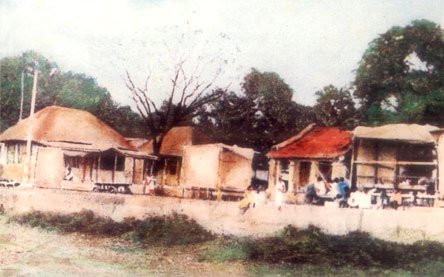
That is the work, and it is not finished, any more than the house of science by the Padma was finished on the day the last of the old workers walked out of the ashram, with their tools left lying where they were.
Somewhere, someone is still waiting to pick them up.