Thakur · 2 of 7
The Life
In the late summer before he was born, the house at Himaitpur, in the Padma country of eastern Bengal, was a house of mourning. Manomohini’s young brother had died at sixteen, and her own child, by the household’s count, was long past its time. Her mother lay in the shrine-room and wept by day and by night. Manomohini went on with her work, and the Name ran beneath every task: sweeping the house, plastering the courtyard, cooking and serving.
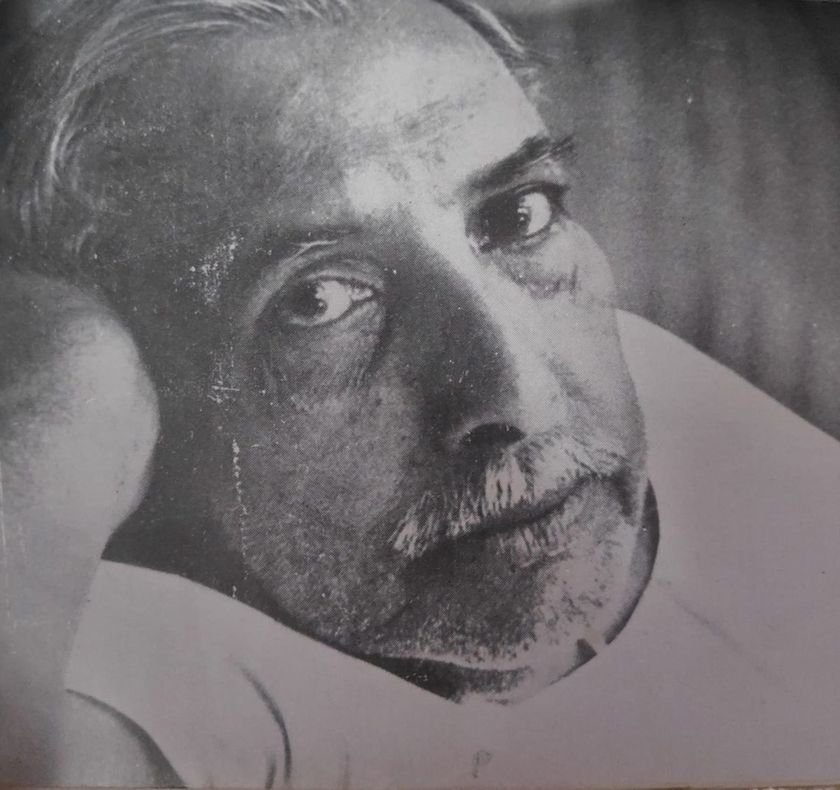
Then, one morning when dawn was near, the time came. No cry of pain came from the lying-in room. Everyone in it fell into a sudden doze, and almost at once they were woken by a blaze of light. A child had been born without their knowing it, fair and radiant. It was an autumn morning in 1888.
A child who did not cry
The women gave the high trilling cry with which Bengal greets an auspicious moment, and people came running from every side. Then they noticed something that astonished them. Every newborn cries. This one did not cry at all. He lay with a calm face, smiling softly, his eyes wide open, looking all around him.
His grandmother looked into the bright face of her daughter’s son, and her scorched heart grew cool. Before he could do anything at all in the world, his coming had cooled a grieving heart. It would not be the last.
His mother named him Anukul, which means “favourable”. What she had longed for was a son who would live for others, who would ease suffering and lift up whoever came to him.
Seeds differ
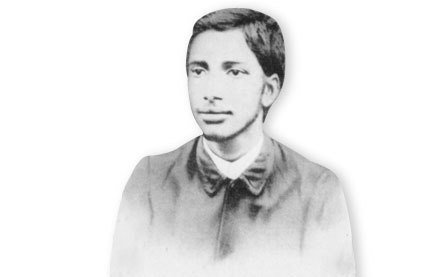
As a schoolboy, Anukul could not leave one question alone. All around him grew trees of so many kinds, and they all came out of the one soil. How could so many trees come from one earth?
He took the question into the jungle and sat there thinking about nothing else. When he could not settle it, he would sometimes burst into tears, and go on doing the Name. Then he set to work. He dug into the soil, lifted out the roots, and searched root, flower, leaf and branch for the cause. In the Basus’ garden next door he pulled up small plants again and again. The same soil, and so many kinds. Why?
Suddenly it came to him. The soil was one, but the seeds differed, so the look of the trees differed and the fruit differed. The soil might make the kind better or worse, but the seed carried the kind. It was a question he would carry a long way.
The rasagolla vow
Money was short at home, and the boy had a tremendous craving for rasagolla, the Bengali sweet of curd cheese soaked in syrup. He ate on credit until the debt grew and the confectioner threatened to throw a towel round his neck and collect by force. “A gentleman’s son! Are you not ashamed?”
Stung, he somehow raised the money, paid off the whole debt, and made a vow: never again would he eat sweets on credit, and he would master this greed, whatever it took.
The test came later, when the craving rose with all its old force and he had five and a half annas in his hand. He set off for the shop, and his feet would not listen to him. Beside the road was a field of arhar, the tall pigeon-pea. He turned into it and lay down. “I will not get up,” he told himself. “I will not go to the shop. Let’s see who can take me there.” He seized the plants and held on, eyes and ears shut tight, until the stout plants tore in his fists. Nearly an hour went by before the storm in him died down. Then he ran to the Padma, threw the coins into the river, and walked home at peace.
In the days that followed he found the secret of it. The moment the urge pressed, he took up some other work and filled the hour with it, and the urge passed. For three full years he did not touch rasagolla. It was a small discovery, made by a schoolboy over a few annas. The man he became would hand it on, over and over, to people fighting far greater hungers than his.
The son of light
The Name had been with him from the beginning, rising in him of itself. One day, walking home from school, at a spot where the ground was all mud and standing water, the whole world filled with light, red and blue, like electric light, and all creation floated in it like countless bubbles. He fell unconscious, face down in the mud. The milk-seller of the household found him and brought him home.
From childhood he had prayed in his own words: “Supreme Father! You are my father, I am your child, your strength is my strength.” An educated devotee told him this was pride; he should call himself weak, a sinner, base and impure. Anukul took the advice. Within a few days fear and guilt closed in around him, and he could hardly lift his eyes to anyone’s face. At last, one evening as the sun was setting, he went down to the bank of the Padma and cried out:
“I am not a sinner, I am not weak, I am not base, I am not a wrongdoer. I am your child, O Supreme Father! I am stainless, I am pure, I am the son of light, I am eternally luminous.”
As he spoke, his chest grew light and his strength came back. He never again laid such burdens of weakness on himself.
Six annas
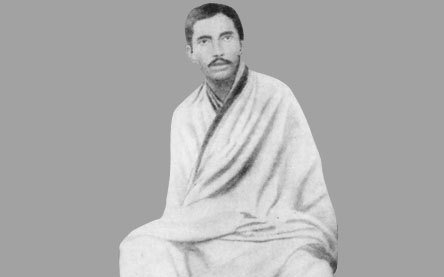
At the end of his schooldays at Naihati, his father sent him the fee for the Entrance, the examination that opened the door to college. Then Anukul heard that a poor classmate could not raise his own fee. He went straight to the boy and put his father’s money into his hand. “Brother, don’t worry about money. Take this and deposit your fee.” The boy sat the examination and passed. Anukul never sat it, and let no one know the reason.
As a medical student in Calcutta he lived on ten rupees a month, and then the ten rupees stopped. One day he had six annas left in the world. Then a friend came to him in great trouble, needing at least eight annas at once.
Anukul did not have eight annas. He had six. He gave him all six.
After that he lived on water from the tap, until on the third day the pain in his empty stomach made him faint. He wrote home about none of it.
His lodging was a corner in a coal store on Grey Street. When there was no room even there, he slept on the footpath, or on the paved yard of Sealdah station, one sheet of newspaper beneath him and another wrapped round him, and read his books under the street lamp. He never had the money for the tram. Nor, in the days when horses drew the trams, had he ever ridden them: he had once seen a horse fall on its face in the traces, and it had pained him so much that he would never get on those trams.
Around the coal store worked many poor coolies. Between his studies he went among the sick with a box of homeopathic medicines a friend had given him, and never asked a fee. At night a crowd of them walked behind him with his medicine box on their heads, to see him home. “Daktarbabu,” they would say, “you are our father and mother.”
Daktarbabu
He came home to Himaitpur with his training, and with no post and no money. Like everyone else, he applied for a salaried post, and a letter of appointment came from the Tagore estate at Shilaidaha: fifty rupees a month, with quarters and furniture. The family was in grave want, and he knew his father would make him take it. He said not a word. He tore the letter to pieces, and resolved to give himself to the service of everyone through medicine.
When he was in his middle twenties, cholera came to Himaitpur and the villages around it, and his parents would not let him near the sick. He pleaded with them. “I took such pains to learn medicine. If I can’t use it to serve people in distress, then what was it all for?” At last they allowed him one day. He walked fast from dawn to dark, house to house, through Himaitpur, Kashipur, Pratappur, Chhani, Pailanpur, Nazirpur and other villages besides, and arranged treatment for patients in their hundreds. In the days that followed, every patient who had taken the medicine was mending.
He practised allopathy and homeopathy alike, and Ayurveda when a case called for it. “Curopathy,” he called it: anything that cures. If a patient could not afford the medicine, he bought it himself, and when it was needed he cooked the patient’s food with his own hands before he left. The villages began to call him simply Daktarbabu, the doctor.
The night the Name overflowed
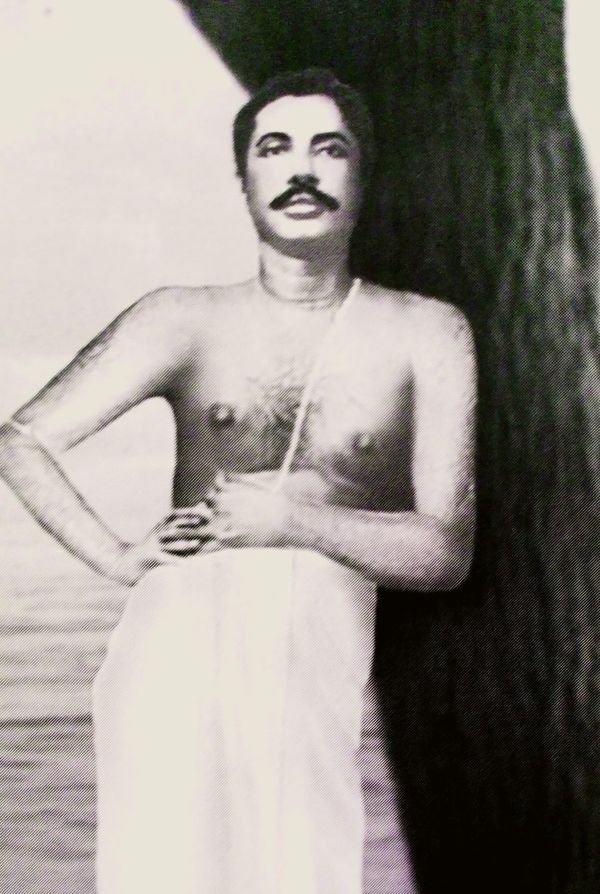
He did not keep the Name to himself. With a band of village boys he began to sing kirtan, the Name sung aloud to drums and cymbals, and soon he was leading it through the river villages from dusk until midnight, and sometimes until dawn. In the dispensary room of his friend Kishorimohan Das, as the boys sang with all their might behind a shut door, the ecstasy of the Name came upon him and he fell senseless to the floor.
One day his body began to move by itself into postures, one after another, as if there were no bones in him at all, and then words came from his lips. Another day a boy named Mukunda, wanting to know whether the state was real, held a burning match to his finger until a blister rose. He made no sound. When he came round and heard what had happened, he laughed, and scolded as he laughed: “Testing a living man by setting fire to him! Don’t you ever do such a thing again!”
Deep in a summer night, at the house of his boyhood friend Anantanath Ray in Kashipur, he was singing Swami Vivekananda’s hymn of samadhi when he began to slip from his chair. The men caught him and laid him on a mat. Whatever he had said on other nights was lost, for nobody had written it down. This time they took it down. The first sentence anyone caught was in Bengali: Āmi chāi śuddhātmā, “I want a pure soul.” By the end of the night they had sixty-five utterances on paper.
It happened again and again over the next five years, until 1,467 utterances had been taken down. He would lie as still as a corpse while the big toe of his right foot trembled. When they put a stethoscope to his chest, they could find no action of heart or lungs. He himself could not explain it. The words came through him, and he did not know what he would say.
“Let them call me Thakur”
Around him the companions of the kirtan were changing. A thief gave up stealing; a libertine forgot his ways; old village quarrels vanished. He had not argued them out of their ways. He had loved them, and the change had followed the love, as the crop follows the rain.
Calling him “Daktarbabu” no longer satisfied them. Out of simple love, some began to call him “Prabhu”, Master, and some “Thakur”, the word Bengal uses for the Lord, and for a holy man. He did not like it at all, and forbade them again and again. Nobody paid the slightest attention. At last he consoled himself: “People call even the cook-Brahmin ‘Thakur’, don’t they? So if these people get a little joy out of calling me ‘Thakur’, let them call me so. What else can I do!”
So the name came, and it stayed. The young doctor of Himaitpur was Thakur now.
Love for those who meant him harm
Krishnachandra Das, a young man of Kashipur whom Thakur had helped in his poverty and set up with a printing press, came to believe that Thakur’s place should be his. During a long illness of Thakur’s he told people that this time Thakur’s death was certain, drew a few men to his side, and through them, in secret, began to plot to kill him.
Thakur knew. He did not send them away. He drew some of the men who were seeking his life very close, and left himself in their hands. He rubbed oil on their bodies with his own hands at bathing time, and ate with them from the same meal. One of them could not bear it. Burning with remorse, he ran to Thakur one night, fell at his feet and told him everything, and Krishnachandra fled. In time, when Krishnachandra had fallen ill and into want, Thakur, without a moment’s hesitation, paid for his treatment and his family’s keep.
A few years after that, when the old ease between Hindu and Muslim was breaking down across Bengal, a rumour turned the villages around against the ashram, and a crowd set out to attack it. Thakur sent word that no one was to keep any weapon, and stood alone on the embankment in front of the ashram, in the very place where he would be the first to fall. The crowd broke and fled before it reached him. That night senior police officers came from Pabna and asked him for the men’s names, so that they could teach them a lesson.
Thakur smiled a little, humbly. “Can a man be changed by bodily punishment? My discipline is of forgiveness, of love.”
Afterwards the village men who had joined the attack, starving now and afraid, came weeping and fell at his feet. “Never do a thing like that again,” he told them. “From tomorrow morning get to work at the ashram. And take some money, and keep the little ones alive.”
Dasda
Chittaranjan Das was the foremost leader of Bengal, and he was not well. One evening he came to the house in Calcutta where Thakur was staying, and was taken up to the roof terrace, where Thakur lay on a mat. Thakur called him “Dada”, elder brother, and seated him close beside him.
They talked of the country. “Truly, there is no way to win a country except through service,” Thakur said. “To remove all of a people’s wants through service, to keep them healthy and help them grow: that, to my mind, is the highest politics.” Das opened his heart, and asked what he must do. “Take strength, and set to work,” Thakur said. “Who will give me strength?” “The very moment your love falls on Him, strength will come.” That same night Das took the Name.
Later, staying at the ashram by the Padma, he stood alone late one night on the embankment above the river. “Mother,” he said aloud to his country, “shall I never see you free?” Thakur, coming up behind him, cried out, “Surely we shall, but there is still much work to be done.”
At Darjeeling, not long after, Das told Mahatma Gandhi of his guru: “He has given me strength I did not possess before.” Soon afterwards he died there. The loss struck Thakur so deep that he could not go to the last rites.
A village drawn into life
Himaitpur was hemmed in by jungle, wasted by fever and torn by quarrels, and from boyhood he had felt its sorrow. Now, with the workers gathered around him, he set about drawing it into life on every side. There was no money, so everything was made by hand. When masons came from Dhaka, he set the schoolteachers and their boys to watch them and bought them every tool of the trade, and soon the ashram had masons of its own. The bricks were made at night. The men dug and worked the clay, and the women, saris tied tight at the waist, slapped it into the moulds until dawn, while Thakur stayed awake with them in the field. A press was set up, and the women became its compositors. The Tapovan school rose from the hands of its own boys and teachers, and a power-house carried electric light through the ashram. When the women gave their ornaments for the new village bank, he handed them back himself. “Ma, I am your son. Can a son ever take his mother’s ornaments?”
In the days when the ashram had not a paisa and its workers did not yet get two meals a day, he said, laughing, “Try to raise funds for founding a science laboratory here.” Many thought it a jest. It was the most intense longing of his heart. The work began in a few small huts, and in time the Vishwa Vigyan Kendra, the science centre he loved above all the ashram’s works, rose by the river. One night, at the microscope, he said: “The scientist is the rishi of this age.”
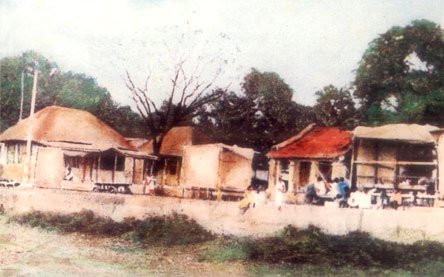
Shelterless
His mother had stood beside him through all of it. Then came an illness that would not lift. Just before noon one day, at sixty-eight, Manomohini Devi left this world.
What happened to her son then, those who saw it could never put into words. He struck his head with his hands and cried, “Nirashray! Nirashray!” “Shelterless! Shelterless!” He took the pillow that had lain under her head, clasped it to his chest, and wept. Again and again he turned towards the cremation ground and called out: “Ma, you didn’t come! Ma, you didn’t come!”
In the hungry years that followed, he became a shelter for others. Long before anyone dreamed of famine, he began to say, “The days of eating lapsi are coming again,” lapsi being the thin gruel of hard times. “Tell everyone to lay in a year’s rice and dal.” Rice was cheap, and people laughed.
Then the war came close, the rice that Bengal bought from Burma stopped coming, and Bengal starved. Crowds of the hungry came daily to the ashram’s door, and the rice laid in against everyone’s laughter went out to them: to the ashram, to the villages round about, and to the destitute who had come from Burma with nothing. In the ten or twelve villages around the ashram, he did not let a single person die.
One cloth
At nearly fifty-eight his body was failing him, with high blood pressure and a weak heart. The doctors begged him to live somewhere quiet, away from crowds. He never agreed; he would not live apart from people. Around him Bengal was on fire, and the killings in Calcutta lay heavy on him. At last, of his own accord, he said he would go away for his health, and named the place himself: Deoghar, in Bihar.
On the last morning rain was still falling at dawn. When the news spread, people came, old and young, and stood in silent tears. From village after village Hindus and Muslims came running. Dulal, born in a family of sweepers, whose work was to clean the ashram, stood before him with folded hands and wept, and tears came to Thakur’s eyes. Late in the morning he stood beside the car, waiting for his wife. When she came, she too had nothing with her. He told the driver to go.
So he went out from Himaitpur, the village where he was born, where he had played as a boy, healed as a young doctor, and built, out of nothing, a whole world of work and worship. He went in a single cloth. Beside the driver, a companion held the cloth he had bathed in that morning, still wet. He took nothing in his hands. He took his people.
Beginning again at Deoghar
At Deoghar a house had been rented for him in haste: Boral Bungalow, on the road to Rohini. On the first evening he sat out on the veranda, bright and happy, talking freely with everyone. To those who saw him it seemed as if, after a long, long time, he had come to his own place.
A year later the country was divided, and Pabna and Himaitpur became part of East Pakistan. Families who had lost everything came to Deoghar in droves to seek his shelter. He was himself an exile, stripped of everything, but he could not turn them away. House after house was rented, and four thousand rupees a month went in rent alone. Dhurjatikrishna Niyogi, who had been left in charge of the school at Himaitpur, heard that to raise it Thakur had one day gone barefoot, with folded hands, begging at the doors of his own people. When a landlord asked for his house back, Thakur pleaded: “I am a Brahmin’s son; I too had a household, I too had a home. I never once imagined that I would have to pray to you like this, like jackals and dogs, for a little shelter.”
At Deoghar they began again from nothing, and for a time the whole company managed one half-filling meal a day. “Pabna had not been small,” Thakur said in a talk there. “I came away in a single cloth. But afterwards everything sprouted up again. Did you ever perceive that there was nothing?” And another day: “People say, ‘What a great loss!’, but it does not touch me. But man is very precious to me.”
Little by little the ashram put down roots. Along Rohini Road empty holiday houses were taken one by one, and in them the press began again, and a machine shop, the school and small industries.
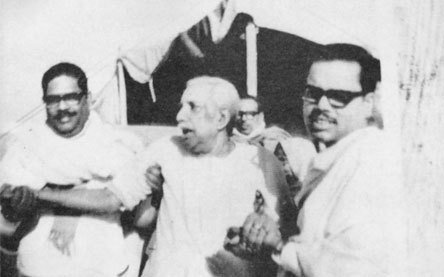
The field below Digheria
In his last years at Deoghar his body was slowing. When he was eighty, he began to ask, again and again, about his mother. “Where is Ma? How is Ma?” She had been gone for more than thirty years. Whenever anyone reminded him of it, he wept, and then asked again, like a child who cannot understand.
That January, almost every morning, he was driven out at first light to an open field below Digheria hill. On the last of those mornings he sat in a tent on the high ground while his companions scattered down into the valley, some towards the woods for wild berries, some towards the railway line. He watched them go further and further, and there was worry in his face. He called a boy sitting by the tent-pole and pointed across the valley.
“Look how far they have gone.”
“Yes, Thakur,” said the boy. “They are going for a walk.”
A smile came over his face. He kept looking down into the valley until they came back, one after another, and everyone who had come out with him that morning was there. Then he rose, glad and untroubled, and took the road home. Those who watched him walk slowly to his room thought they had not seen him look like this for a long time.
That evening he ate with satisfaction and slept soundly. Before dawn a terrible breathlessness came over him, all at once. Everything that could be done was done, and nothing helped. On that winter morning in 1969, Thakur Anukulchandra passed away. He was eighty years old.
A cry of grief went up in his room. Outside, the kirtan went on. There was a thick fog that day. That morning he did not go out to his field below Digheria hill.