

Thakur
Thakur Anukulchandra
Village doctor, teacher and builder of Bengal, 1888–1969
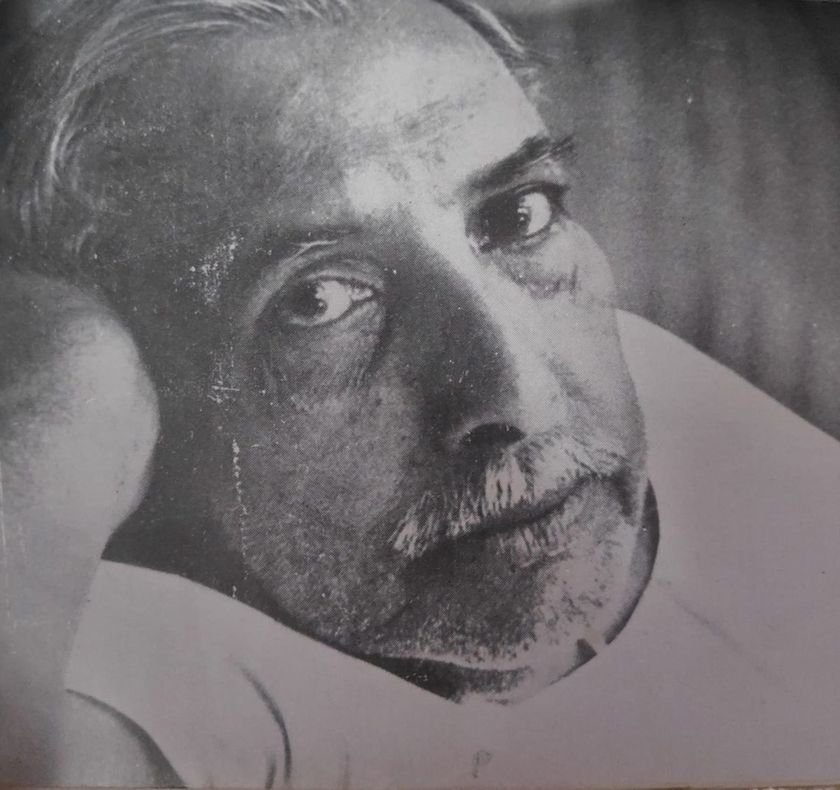
Sree Sree Thakur Anukulchandra (1888–1969), known simply as Thakur, was a physician, spiritual teacher and builder from Himaitpur, a village on the Padma river in the Pabna district of Bengal. Trained in medicine in Calcutta, he treated the poor of the river villages without asking a fee, buying their medicine himself when they could not. Around his home there grew a community of more than a thousand people, with a school, a press, workshops, a power-house and a science centre, built by workers who drew no salary. In 1946 he left it all, in a single cloth, and began again from nothing at Deoghar, where he lived until his death.
He is remembered for the unusual reach of one life. A doctor who begged for a spectroscope and an X-ray apparatus for a village laboratory, he was also a teacher whose recorded words fill many volumes, on subjects from the care of children and health to marriage, farming, the State and the meaning of existence. Chittaranjan Das and Mahatma Gandhi came to see him, and so did scholars sent to inspect his laboratories and visitors from the West; he talked in the same way to a ploughman, a minister and a schoolboy. Asked whether he was God, he said it was “not even the right question to ask”.
You do not need to believe anything about him to read here, and nobody is asked to change their religion. These pages give his life as the people beside him saw it, and his words as he gave them, with their sources. Each section below opens onto a fuller page.
Why him, and why now? We believe he is needed today more than ever before. In an age that distrusts gurus, he told his followers, “Don’t make me your Lord and Master.” In an age of anxious minds, he was a doctor first. In an age that sets science against faith, he begged for a laboratory before there was food. In an age divided by religion, he asked nobody to change theirs. Why him, and why now, and what we are doing about it →
What sets him apart
These are facts from his life, not claims about it. Each is told in full in the sections below and on the pages they open onto.
- A doctor before a teacher. He took no fee for a visit and no price for medicine, and gave away his last coins to a friend.
- A teacher who built. A school, a press, a power-house, a Chemical Works and a science centre rose in a village, built by people who drew no salary.
- A laboratory begged for when there was no food. He asked for it when his workers did not yet get two meals a day.
- A refusal of praise. “Of praise I know nothing.” “Calling me Thakur becomes meaningful only when you rouse the Thakur within you.”
- A distrust of miracles. “Those who depend on miracle have ignorance for their foundation; they cannot go far.”
- Reverence for every faith. His followers at Kushtia kept the birthdays of Rama, Krishna, Buddha, Jesus, Hazrat Muhammad, Chaitanya, Ramakrishna and Vivekananda.
- Forgiveness of those who meant him harm. He kept close the men who plotted his death, and later paid for the treatment of the man who led them.
- Everything lost, and begun again. He left a life’s work behind in a single cloth, and built again from nothing.
Early life
Main articles: The Life · His Mother
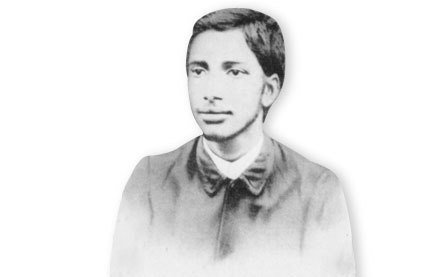
Anukul was the first child of Shivchandra Chakraborty and Manomohini Devi. His mother, a woman of strong will and deep devotion, kept him under a strict rule, and pleasing her was the one prize he sought as a boy. From early childhood he could not bear another’s pain: he wept until a fish was freed from a hook, and until his mother gave him two rupees to buy back a boatload of gasping fish and let them go. He finished school at the high English school in Naihati, a railway town on the Hooghly above Calcutta.
Physician of the river villages
Main article: The Life
He studied medicine in Calcutta in great poverty. When a friend needed money, he gave him his last six annas and lived on water from a street tap; he would not ride the horse-drawn trams, because he had once seen a horse fall in the traces. Back at Himaitpur the villages called him Daktarbabu. He used whatever cured, allopathy, homeopathy or Ayurveda, and called it “curopathy”. When cholera came, he went from house to house through six villages in a single day.
The kirtan years and the name “Thakur”
Main articles: The Life · Who He Is to Us
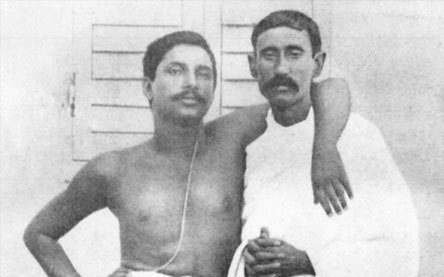
In his mid-twenties he led bands of kirtan singers through the villages, and during the singing he began to pass into states in which he spoke while lying still. Those around him wrote the words down: sixty-five utterances on the first night, and over the next five years 1,467 in all. The men of the villages changed; old quarrels faded, and a thief gave up stealing. People began to call him Thakur, a word Bengal uses for the Lord and also for a holy man. He objected, many times. At last he gave in: “People call even the cook-Brahmin ‘Thakur’, don’t they? So if these people get a little joy out of calling me ‘Thakur’, let them call me so.”
Himaitpur: a village that lived and grew
Main article: What He Came to Do
Around his family’s homestead grew Satsang, the community he founded. In time the village held the Tapovan school, whose classes met under the trees; a dispensary; a press, where the women of the ashram became the compositors; workshops and cottage industries; a power-house; a Chemical Works; and the Vishwa Vigyan Kendra, the World Science Centre. He told the teachers and schoolboys to learn the masons’ work, and they did. When the ashram had not a paisa and its workers did not yet get two meals a day, he asked one of them to raise funds for a science laboratory; many thought it a jest. He begged for its instruments one by one. His workers even sank borings in the riverbed for the Hardinge Bridge works, and the engineer in charge certified the work.
His teaching
Main articles: What He Came to Do · Conversations
At the centre of his teaching is dharma: whatever upholds one’s own life and growth along with that of others. In his own English:
What makes anything stand on
with life and growth
is Dharma.The Message, vol. II · his own English
A person grows, he taught, by loving and following a living Ideal, a real person whose life can be studied and followed, rather than a set of rules. He gave the day three practices: Yajan, one’s own worship and self-cultivation; Yaajan, turning the same love outward in service of others; and Ishtabhriti, a small daily offering to the Ideal. He held all the great teachers before him in reverence, and spoke of Ram, Krishna, Jesus and Hazrat Rasul as his forerunning teachers.
His words cover almost every side of life. One early collection, Anushruti, holds 1,941 short rhymed sayings on thirty-one subjects, from the care of children and the conduct of health to marriage, varna, agriculture, the State and the Ideal; in three years at Deoghar he gave more than three thousand sayings. Some of his teaching, on marriage, heredity and varna, is hard for many modern readers. It is given on these pages in his own words and in its setting, neither softened nor hidden.
Science, the mind and the questions people brought
Main article: Conversations
For him science and the search for God were one search. “The scientist is the rishi of this age,” he said. He spoke of existence, responsiveness and becoming as the meaning of Sat-Chit-Ānanda, of the mind’s complexes as things to be adjusted rather than suppressed, and of heredity. One visitor put more than two hundred questions to him in eleven days. When a close companion asked him for some sayings in English, for those who knew no Bengali, he began to dictate them in English, and they were printed as The Message. A later book of English stanzas, Magna Dicta, followed.
Visitors and companions
Main article: The Life
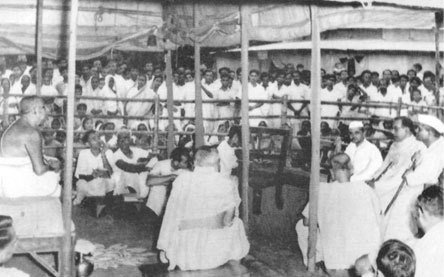
Chittaranjan Das stayed by the Padma and said of him, “he has given me strength I did not possess before”; Mahatma Gandhi printed the words in Young India. Gandhi came to the ashram, and met Thakur again in Calcutta. When Gandhi told him, laughing, that some eminent men had praised him and others slandered him, he answered: “Of praise I know nothing. But if you heard some slander, then I take heart.” Subhas Chandra Bose, whose parents were among his followers, would not sit on the chair he was offered, and sat on the floor. Prasanta Chandra Mahalanobis and Satyen Bose were among the scholars who walked through his laboratories.
Famine, exile and Deoghar
Main article: The Life
Before the Bengal famine he told people to lay in a year’s rice; in the ten or twelve villages around the ashram he did not let a single person die. When a crowd once set out to attack the ashram, he forbade any weapon and stood alone in front of it; afterwards he refused to give the police the attackers’ names. “Can a man be changed by bodily punishment? My discipline is of forgiveness, of love.” In 1946, with his health failing and riots spreading across Bengal, he left Himaitpur for Deoghar for a change of air. He went in a single cloth; the school, the laboratories and the workshops stayed behind. At Deoghar the company began again with one half-filling meal a day. “People say, ‘What a great loss!’”, he said, “but it does not touch me. But man is very precious to me.”
Last years and death
He lived at Deoghar for more than twenty years, and the ashram grew again there. In his last years he asked again and again for his mother, who had been gone for more than thirty years. On his last morning out, in a field below Digheria hill, he watched his companions walk far across the valley, and would not leave until every one of them had come back. He died before dawn the next day, 27 January 1969, at eighty.
How he spoke of himself
Main article: Who He Is to Us
When a visitor asked him whether he was God, he said: “That is not even the right question to ask… What is a shaligram to itself but a stone? To learn its worth, you must ask the one who has come to know its worth.” At Deoghar he put it another way: “Call me God, call me Avatara, call me Brahmin Thakur, or call me Anukul Chakraborty, son of Shiv Chakraborty… call me whatever you call me. What I am, I am.” At the threshold of Satyanusaran, written in his early twenties, he set a warning to anyone who would follow him for name or riches: “Don’t make me your Lord and Master.”
Reading him today
Main article: Why Him, and Why Now
His own warning, that even his followers could become “a narrow enclosure” if they went against what he said, applies to everyone who carries his name, Master Within included. So these pages quote him only from his own text, with the book and the place in it; his own English is kept exactly as printed; and our explanations are marked as ours. Anyone may ask us for the source of any line.
Read further
- Who is Thakur?: a short reading, in one sitting
- The Life: from the village on the Padma to his last days at Deoghar
- His Mother: Manomohini Devi, and what she was to him
- What He Came to Do: dharma, the living Ideal, and a village built to live it
- Conversations: the universe, science, the mind, and the questions people brought him
- Who He Is to Us: Master Within’s faith, said openly
- Why Him, and Why Now: why he matters today, how his words are kept as he gave them, and what Master Within and Vishwa Vigyan are doing
How we use his words
When we quote Thakur, we give the exact passage and, wherever it has been checked against print, the translator, the work, the edition and the page; where it has not yet, we say so. Our own explanations are marked as ours, so you can always tell his words from our understanding of them.
Walk with us
- Living Wisdom, the weekly classFridays, 16:30 UTC, in Bengali and Hindi. You can just listen.
- Ask a questionAbout him, his words, or where a line comes from.
- The daily saying and newsletter (opens in a new tab)Short readings by email, free.
- Want to talk to someone?A person from Master Within reads every message. No conditions.
Where this comes from
- Souvik Ghosh, The Living Ideal: The Life of Sree Sree Thakur Anukulchandra (in preparation), Draft 6: the Author’s Introduction, the Prologue and chapters 2–5, 7, 10, 11, 13, 14, 16, 19, 21, 23, 24, 25, 28, 29, 33, 35, 36, 38, 39, 41 and 45. The dates of his birth and death are those of the book.
- Souvik Ghosh, The Way of the Living Ideal (in preparation).
- The sources those books rest on: Brajagopal Duttaray, Sree Sree Thakur Anukulchandra, vols 1–3 (Bengali); Thakur’s recorded talks at Deoghar; the dated books of his discourses; the memoirs of those who lived beside him; Mahatma Gandhi’s article in Young India, July 1925.
- His own English: The Message, vol. II; the 1950 English of Satyanusaran, read out and approved in his presence.
- Every quotation on this page is given with its full source on the page it comes from.