

Thakur · 5 of 7
Conversations
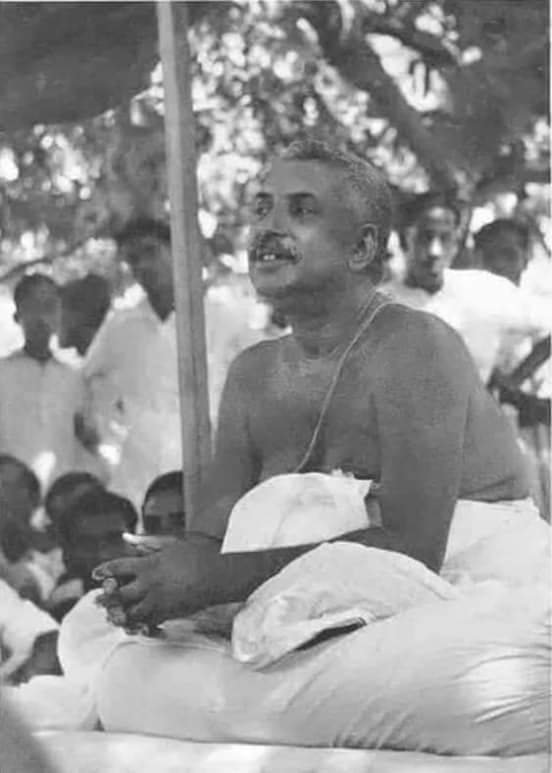
People came to him with questions. A young professor of physics with a head full of electrons and doubts. An elderly lawyer and an elderly pleader on a bench beside his tent. A doctor who wanted to know whether he believed in ghosts. A man who had been a minister in Bihar. An American who had carried the wounded of the war. Thakur Anukulchandra sat in a chair by the Padma, on a bench under a mango tree, on a wooden couch in a small tent while the river rose and fell, and later on a veranda at Deoghar, and he answered them.
He never sat down to write a system. Someone asked; he answered; someone wrote it down. Here is a little of what was said in those rooms.
The universe and its beginning
On the morning after Dol Purnima, the spring festival of colours, he came and sat on the veranda of Jatin-da’s cottage at Himaitpur, and a few of the brothers came and sat with him. After some talk he asked them, “What does the word chaitanya mean?”
“Chaitanya comes from chit,” someone answered. “Chit means knowledge. It is a quality of sat, of being.”
“Then it comes to this,” he said. Sat, existence, is that which has the capacity to push back when it meets opposition; ananda, bliss, is the continuance of that push. “Then everything is consciousness. There is nothing that is inert. For this reactivity, this response to stimulus, is there in everything, from the Cause onward.”
Later he gave the same three old words their meaning in his own English:
He is the existence of all that exists, thereby He, the Sat ; He is the responsiveness of all that respond, so Chit—that He is ; He is the becoming of each that becomes, thus He, the Ananda as known, He made Him Himself,-- materialized with the matter of Sat-Chit-Ananda that of Him and His which is and was.
Magna Dicta, no. 75, in his own English
Existence, responsiveness, becoming. That is what Sat-Chit-Ānanda meant in his mouth.
Another day he drew the creation for his listeners in pictures. In the one Cause a stirring began, of attraction and repulsion. The stirring became vibration, and the vibration, continuing, became current. “The restlessness of the One is ‘I am one, let me be many’.” One made two; two, with the Cause, made three; and so on, like rings spreading from a stone dropped in water.
When he had explained it all with his drawings, he said plainly what was his own in it. “There is no other difference from existing philosophy. Existing philosophy goes as far as the ego. In my philosophy there is a description of the finer strata above it, up to the Cause — what is new is only about the ego’s gradual sleep and gradual waking.”
At Pabna he put the beginning into one sentence of English. It stands at the head of The Message:
The booming commotion of Existence that rolls in the bosom of the Beyond, evolves into a thrilling rhyme and upheaves into a shooting Becoming of the Being with echoes that float with an embodiment of Energy- that is Logos, the Word — the Beginning !
The Message, vol. I, “The Revealed” I, p. 15, in his own English
And in a later volume, more plainly:
I do not understand theology, but I understand the Logos of God— the invoking urge of life— i.e., ‘be’ which turns into being— the inherent stimulus in everything with different actions and attributes.
The Message, vol. VIII, Philosophy, no. 138, in his own English
Science and the Name
It was in the days when the ashram had not a paisa to its name, and its workers did not yet get two meals a day. One day, talking with one of the brothers, he said to him, laughing: “Try to raise funds for founding a science laboratory here.”
Everyone who heard it was astonished. Research in science, here, in this insignificant village? Many thought he had said it only in jest. No one knew then that it was the most intense longing of his heart. When talk turned to the country, he would often say the same thing, and he did not say it lightly.
“If we stay blinded by the glory of our past, and ignore the brilliant modern achievements of Western science — if we do not churn the ocean of nature and discover ever-new truths to increase the wealth of the nation — then our death is certain.”
There was a microscope at the ashram by then, and he used it. One autumn night he sat at it and looked at the living seed of man. “They come down to create, like comets,” he said. “The mystery of creation lies within this.” And then:
“Science seems to be leading man toward unity, in a vast plan — melting all the manyness and leading toward the One. The scientist is the rishi of this age. … If only the laboratory came quickly! Once the brain begins to fag, there is trouble. Then perhaps nothing more will come out.”
He wanted the young to learn science in the same restless way, so that they never even noticed they were being taught. “Say one day it begins with eating — and through the meal they have learned some science without knowing where it came from.”
The laboratory that so many had taken for a jest came true. The jungle was cleared. Begging for the money, he gathered one costly instrument after another: a projection microscope, an X-ray apparatus, a spectroscope. On walled land rose a great two-storeyed building, and beside it a second, with rooms for physics, chemistry, botany and psychology and a library of science above. So rose the Vishwa Vigyan Kendra, the World Science Centre.
“The Vishwavijnan is the thing dearest to my heart of all things,” he would say. “Here, away from the noise and crowd of the ashram, in this solitary quiet, to be alone with high thoughts of science and with experiments — I love it.”
For him, science and God did not live in separate houses. One winter night a companion, Hem-da, raised before him the question of the final manifestation. Thakur took a piece of paper and wrote three lines on it:
I am.
That by which I am, is.
That of which each thing is the outcome, is.
The paper set off a long argument, and he lay listening. After a while he sat up. All this while, he said, men had known matter and consciousness as separate things. “The final manifestation can only be called the one who, by demonstration, shows men fully the root thread of all this.” Until now, he said, people knew that the Name took away sorrow, but not why. “In the final manifestation everything will be fully solved.”
The mind
He was a doctor first, and the science he talked of most often was the science of healing. One day, with many sitting near him, the talk turned to how disease begins. “Many of our diseases begin first in the mind,” he said. The mind sets up a pattern in some part of the brain; the pattern reaches through the nerves to some organ of the body, and there the disease appears. In psycho-analysis, the treatment of the mind, suppression hardly happens at all; there the cure is complete. It was his curopathy still, as he called it: allopathy, homeopathy or Ayurveda, whatever cured the patient in front of him.
He set the new psychology beside the old. “Whatever Freud says,” he told Kestoda one day, “you must show its harmony with Patanjali — show where the two are one.”
One afternoon in the rains, clouds had gathered over the ashram. He sat on a bench under the big mango tree, and a few of the brothers sat round him on the grass. Hearing sounds and seeing lights in meditation, he told them, is not realisation. When the complexes break and come under the will, the change in character, that is realisation. “What is to be gained is character, and that is realisation.”
The complexes, the drives and passions inside a person, are not to be fought one at a time. In the tent by the Padma he told his questioners why:
… if … you busy yourself first setting them all right one by one, aiming to increase attachment to your Desired, the more you set right, the more they will break. With what will you keep them joined? The one and only thread for this joining is your attachment to the Best, the Ishta or Ideal! Fasten that thread of attachment, your thread of attachment, to Him, and whatever you wind with it will all stay bound, jointed to your Desired.
Kathā-Prasaṅge, vol. 1, ch. 3, p. 76 · Translated by Souvik Ghosh
Of the healer of the mind he spoke in his own English:
… loving interested attitude so that the patient becomes normally interested and eagerly adhered to the psychiatrist, and the diagnosis of the functional knot in the system, with his physical condition and treatment of the patient accordingly, sometimes with medicines if necessary, are the main things in psychiatry …
… Yoga— that is, adherence to the Love-Lord, the Master Psychiatrist unfolds the inner mechanism of psychic traits.
The Message, vol. VIII, Psychology, nos. 225 and 227, in his own English
And where does a person’s nature come from? He held heredity and freedom together:
The inherited instincts imbibed from the acquisitions of fore-fathers determine the faculties that make one move— that is Pre-destination ;— and the faculties that dwell in those instincts accentuate the innate nature of a being, and make it move accordingly— that is Free will.
The Message, vol. I, “Pre-destination and Free Will”, p. 98, in his own English
Questions people brought him
A learned visitor. One day a gentleman came to him at Himaitpur. After a first question about an old saying, he asked this: “Some of your disciples believe — some say they have even felt — that you yourself are God. … I wish to hear from your own lips whether you are God or not.”
“That is not even the right question to ask,” said Thakur. “Whether I am God or not is hard for me to say. … even if I truly were God, God-I would have become a man with hands and feet, wouldn’t I? So just as you know yourself as nothing but a man, I have no cause to feel myself as anything but a man.” And then: “What is a shaligram to itself but a stone? Throw it at someone, and it will break a bone. To learn its worth, you must ask the one who has come to know its worth.”
A doctor. On a winter morning in the tent by the embankment, a boy named Haran said his father was an exorcist whose ghosts even brought medicine for patients no one could cure. Thakur listened with the keenest interest, asking question after question. Pyari-da, Dr Pyarimohan Nandi, asked him, “Do you believe all this?”
“Until one finds a proper reason to disbelieve, surely it is only reasonable to believe,” said Thakur. “At the least, what is the harm in inquiring with an open mind?” Then he said what he truly wanted. “I would like to see, with the help of scientific instruments, what becomes of a man after he dies — how he is, what he does — and to show it. That I can see and you cannot gives me no happiness.”
A lawyer and a pleader. One morning after prayers two visitors sat on a bench near his tent, an elderly lawyer from Pabna and an elderly pleader from Bogra. The talk turned to gurus, and someone asked why some true gurus worked miracles and others none. “Whatever works come to real, visible expression through a governance of law that lies beyond the reach of the ordinary person’s knowing — these are what people, as a rule, call miraculous.”
The country’s questions. In the years when swaraj, self-rule, was on every tongue in Bengal, someone asked what he meant by it. “By swaraj I do not mean hatred of the English,” he answered. Pressed about what the English had destroyed, he would not take the excuse. “Whatever has been destroyed has been destroyed through our own fault. Had the fault not been ours, no one could have destroyed it. What we need first is education, health, industry, and society.”
Years later at Deoghar, Binodananda Jha, who had been a minister in Bihar, came to see him, and the talk turned to the country’s troubles. “Money is not our wealth — man is our wealth,” Thakur said. “Each one needs every other.”
A student. Manilal Chakravarty, a Calcutta student, had carried one question for years. He found Thakur on the veranda of the Yati Ashram at Deoghar, sitting on spotless white bedding, eight or ten people round him, bowed full length and asked, very humbly, “How can one become a real man?”
“To become a man, one must have a Beloved,” Thakur said, “and be concentric in Him with indomitable unrepelling adherence. A man’s complexes want to drag him away; but if love is greater, they are adjusted, and in the urge of that active, love-lit energy the fine traits of the brain wake up — and individuality, the integrated personality, unfolds by that same path.” [d]
A visitor from the West. Edmund Spencer, an American who had carried the wounded in the war, was initiated at dawn and came to Thakur with his own offering: his father’s knife, a scarlet makal fruit and a handful of white flowers. The makal is lovely to look at, but inside it is black, foul-smelling pulp.
“What does it represent?” Thakur asked.
“Passion.”
“Right. The complexes have an enchanting form. Behind that form hides the hideous figure of Satan. One has to pass beyond that form to reach the court of God.” Then he laughed, shaking all over with it. “So you want me, with the knife your father gave you, to take the foul seeds out of the makal fruit and make a home there for the fragrant white flowers?” Spencer joined his palms. “That means,” said Thakur, “on the foundation of your father’s culture, keeping the beauty of your complexes, the door of God’s mercy has to be opened in your heart.”
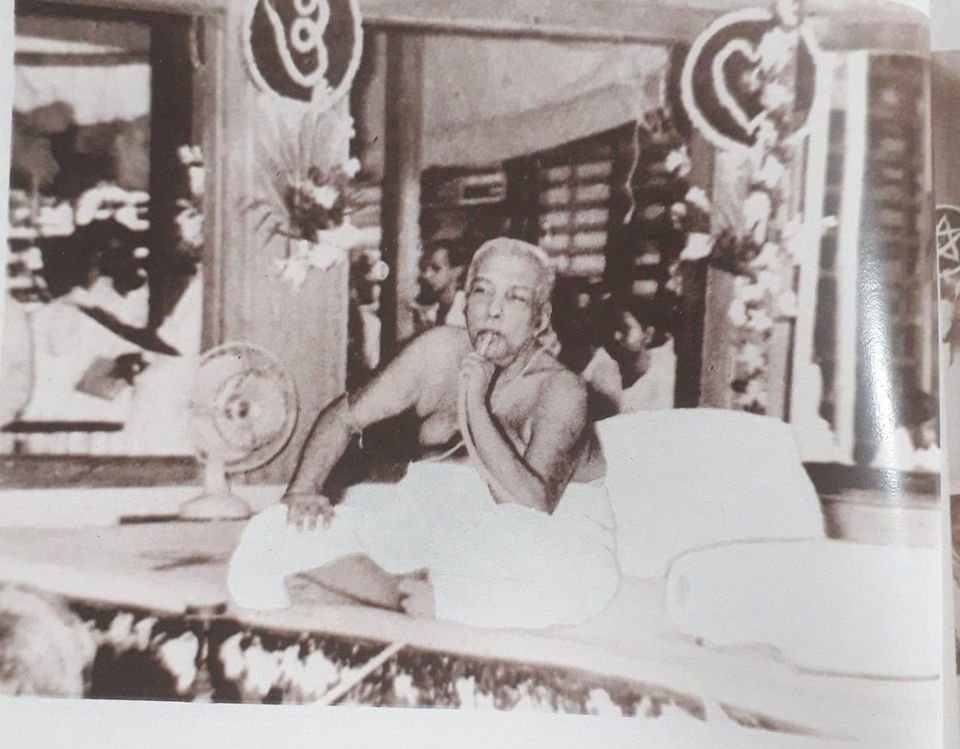
In his later years Kestoda began an English quarterly called Becoming. Thakur wrote its blessing himself, and it gathers much of what he said into a single breath:
Becoming is the cry of Existence, and existence enjoys the universe through it, and feels he exists: Do thou welcome the Becoming, — the uphill move of Being, with every nurture of existence and ever-adjusting go of life, — do enjoy, and help others too with the elixir of life and growth!
Blessing for the quarterly Becoming, in his own English