

Thakur · 6 of 7
Who He Is to Us
For years his companions at Himaitpur had called him Daktarbabu, Doctor Babu. Then, in the years of the kirtan, calling him that no longer satisfied anyone. To treat him as an ordinary man, one of themselves, began to make them ashamed. Out of a simple love, some began to call him Prabhu, Master, and some Thakur, the word Bengal uses for the Lord and for a holy man.
He did not like it at all. It was a title that set him above others, and he objected, many times, in many ways. Nobody listened. At last, when there was nothing else to be done, he consoled himself with a thought:
“People call even the cook-Brahmin ‘Thakur’, don’t they? So if these people get a little joy out of calling me ‘Thakur’, let them call me so — what else can I do!”
That is how the name came. Thakur Anukulchandra let them call him by it the way a man lets a child call him by a pet name, because it gives the child joy.
“Could I say such a thing?”
In those years words would pour from him in deep trance during the kirtan, and the men around him wrote them down. Afterwards, sitting with his tobacco, he would talk with them in his ordinary way, and some of the young men would come up to him.
“Thakur, we’ve found you out now! You said it yourself in the words — that you are Parabrahma, the Supreme Self. We won’t let you go now. You’ll have to save us.”
And Thakur would laugh. “Get away, you rascal! Could I say such a thing? But if you want to know the way to reach Parabrahma, I can tell you that. Live by what I tell you, and you’ll get whatever you want.”
Years later a visitor to the ashram put the question to him directly. “…So many people honour you and are devoted to you in this way that I wish to hear from your own lips whether you are God or not.”
“That is not even the right question to ask,” said Thakur. “Whether I am God or not is hard for me to say… Even if I truly were God, God-I would have become a man with hands and feet, wouldn’t I?… What is a shaligram to itself but a stone? Throw it at someone, and it will break a bone. To learn its worth, you must ask the one who has come to know its worth.”
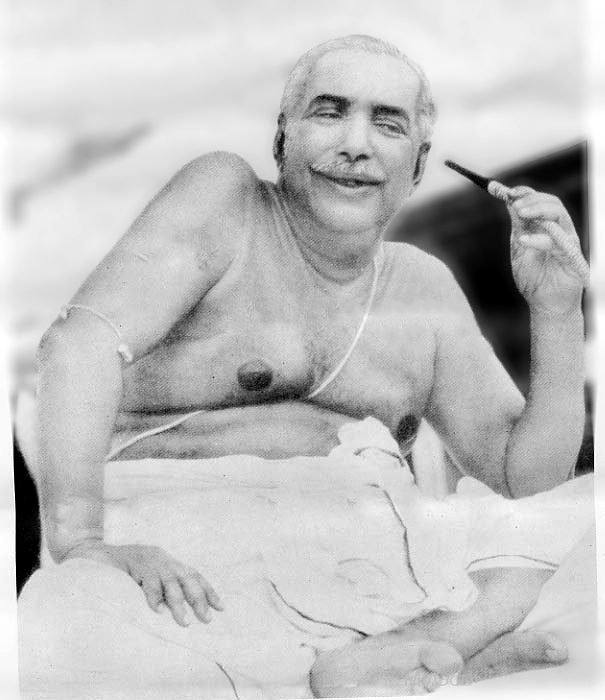
Not a magician
Strange things happened around him, and some of them frightened him. When branches snapped as he looked at them, a trembling seized his chest like an earthquake, and he prayed: “For Paramapita’s sake! If any fault has been committed, forgive it.” A mind that once grew absorbed in such things, he knew, would never get its real work done. He was not going to turn into a magician.
When someone pointed out that people said he had shown so many wonders before, and asked what they saw now, he answered: “Those who depend on miracle have ignorance for their foundation; they cannot go far. Whatever happens in the world has a cause. Where we cannot catch the cause, we call it supernatural. Standing on the supernatural, no pull of love grows — and without that pull, a man gains nothing.”
“What I am, I am”
At Deoghar the people around him had begun to call him God, and he settled it in his own way. “Call me God, call me Avatara, call me Brahmin Thakur, or call me Anukul Chakraborty, son of Shiv Chakraborty, or call me a sweeper, a corpse-handler, a Dom — call me whatever you call me. What I am, I am.”
But if the name was used to keep him at a distance, it stung him. “…To call me Thakur or God is also a device for dodging me. The Supreme Father has given not little within you too. Otherwise, to be called Thakur feels insulting to me. Calling me Thakur becomes meaningful only when you rouse the Thakur within you.”
Visitors who had gone round the institutions at Himaitpur would come back to him full of praise. “Seeing your institutions…” they would begin, and he would stop them at once and point to the workers standing near. “It is they who have done it, with so much hardship — I am nothing, brother.”
Those who came before
Ananta, his friend from boyhood, after long months of silence and meditation, came to know for himself, so he was convinced, that this friend was the full Bhagavan, the fulfilment of every avatar who had ever come into the world, the Purushottama of the age.
Of those who came before him he said, “Ram, Krishna, Jesus, Hazrat Rasul — all of them are my forerunning teachers.” And in his own English:
Be aware— all Fulfiller the Best are the same though in different embodiments ; Their messages are of the same tune though in accordance with the age ; never refute any though you follow One ; remember that the present One fulfils His Fore-runners …
The Message, vol. II, in his own English · “Fulfiller the Best—Same”
The man who stopped every word of praise asked one thing of those who loved him: that they live by what he said. Keeping him as he is, his words as he spoke them and his life as those beside him saw it, is the work of the last page.