

Thakur · 4 of 7
What He Came to Do
A gentleman had come to the ashram at Himaitpur to see Thakur Anukulchandra. He had walked round the ashram’s workshops and schools, and he had a question about what he had seen.
“I went round the ashram’s working institutions, and I liked them very much,” he said. “It seemed to me that every one of these centres is slowly coming into its fullness. Tell me — when they reach their fullness, will that lead toward the attainment of God?”
“Whenever we love someone who loves the Full,” said Thakur, “our life begins to grow fuller.” Then he spoke of the word itself. “And this word ashrama — it comes from a-shram: a place where one advances by labour… All the activity grew up around one rishi at the centre, and out of it grew knowledge, science, society, everything. And because they are won by labour, they are truly won. Otherwise they are not.”
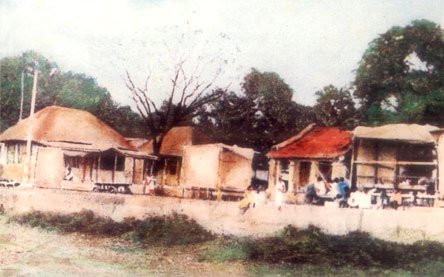
Most of what he came to do is folded into that answer. A life grows by loving one who loves the Full, and what it gains, it gains by labour. He called the law of that growth dharma, and the one to be loved the Ideal. He gave that love a daily shape in three practices. And on the bank of the Padma he built a village where all of it could be seen.
What upholds a life
Thakur did not begin from a creed. He began from what every living thing already wants. “The principal hankerings of Being,” he wrote in his own English, “are animation, extension and augmentation”: to be alive, to reach outward, to grow. Being, for him, was never a fixed thing that one simply has. It is always becoming. He kept the two words together, Being and Becoming, as one fact.
Whatever holds that urge up, and keeps it whole, he called dharma. His definition is short, and its second half is the hard part:
To uphold one’s own life and growth with that of others is Dharma, and to bind oneself with the Love-Lord through sacred devoutness and to follow Him accordingly is religion.
The Message, vol. IX, in his own English · “Dharma and Religion”
Dharma in this sense is not one religion set against others. It is the law every life already lives by: whatever keeps me, and those around me, alive and growing.
He lived the words “with that of others” in the plainest way. In the lean years at Himaitpur more than a hundred people ate from the ashram’s common kitchen, the Anandabazar, the Market of Joy. There was one meal a day: the cheapest coarse red rice, a dal as thin as the Padma’s muddy water, and salt like clay. The day’s cooking went ahead only if Thakur himself went out begging and gathered the money for it. Some days the meal was not ready until deep into the night, and he went without food along with the workers until it was. In those days he wrote in a letter:
“Ma, what more can I tell you of things here? Almost always there is only one meal a day, and even that is hard to come by… Oh, Ma! The sight of their faces breaks my heart… Such a worthless child am I, Ma, that I could not find the means to give anyone two meals of rice. I have decided that from tomorrow I too will throw myself into everyone’s lot. If I can — if they eat twice, I shall eat once; and if they eat once, then I — none!”
His own life and growth he could not hold apart from theirs. That is his whole definition of dharma, lived out in a village kitchen.
Why a living Ideal
If dharma is a law, why does the same sentence turn at once to a Love-Lord, to binding oneself to someone and following him?
Because, he held, the urge to be does not hold itself together. Pulled by every attraction around it, it scatters. In the same passage on Being he says how its hankerings are fulfilled: “by binding back, with attachment to the Ideal”. Not to an idea alone, but to a living Ideal: a person in whom what is taught is already lived, who can be loved as a person is loved. Love does what instruction cannot. It gathers a life round one centre. The scattered passions, which he called the complexes, are not crushed. They are turned, one by one, toward the one who is loved.
More alive the adherence to the Ideal, more is man unshocked and unshaken.
Magna Dicta, in his own English · no. 13
Among those who kept him company was a famous reciter of sacred tales and poet, Hemchandra Mukhopadhyay, whom Thakur called Hem-kabi. He drank, and he drank hard. Once, in Calcutta, the poet came to him thoroughly drunk and sat before him babbling every kind of nonsense. Thakur kept his eyes on him, smiling gently, and listened to it all. After a while the poet said, “Thakur, I’ve just been drinking. The smell of liquor is still on my mouth. And you’re not disgusted with me at all?”
“If one of my fingers is in pain, brother,” Thakur said, “I try only to heal it. Can we ever think of cutting it off?”
Thakur condemned liquor, but he never condemned the drinker. He never told the poet to give it up; he knew that if he did, the man’s stubbornness would only grow. “Thakur,” the poet asked him once, “shall I never be able to give up drink?”
“You need not give up drink. The drink itself will leave you.”
The poet made vows and broke them, again and again, for years. But in the end he gave up liquor altogether. The story went that he said, “When I drink, I can no longer enjoy Thakur’s sweet words.” No rule had done it. Love for a living person had.
Three practices for every day
A love has to be kept alive from one day to the next. He gave it a daily shape in three practices, Yajan, Yaajan and Ishtabhriti. Here they are by their meaning only. In his own English, with his own spellings:
To exalt oneself with pious worship is ‘Jajan’, to exalt others with pious worship is ‘Jaajan’ …
The Message, vol. II, in his own English · “Jajan—Jaajan—Istavriti”
Yajan is one’s own worship and self-cultivation: becoming, each day, a little more like the one who is loved. Yaajan turns the same love outward, to serve others, to help them grow, and by word and conduct to bring them near to what one loves. In him the two were never separate. One morning, with many sitting near him, the Gita was opened at the verse on work done as sacrifice, and he said:
“Yajna means service. If you serve those around you, they too will serve you. If you nourish and build up the growth of your surroundings, your surroundings will in turn nourish and build up your own growth… What is done for the sake of the Ideal is true work; work done otherwise brings only bondage.”
Another morning he was standing under the babla tree in front of the room that was then the library, when a beggar in tattered clothes came up and begged piteously for a cloth. At once Thakur took the torn, dirty, foul-smelling rag off the beggar’s own body and put it on himself, and placed his own clean, fine cloth in the beggar’s hands. The man stood there amazed. Then: “No, no — I never asked you to strip yourself bare to give me clothes!”
The third practice, Ishtabhriti, is the daily offering to the Ideal: something of one’s own, given each day to the one who is loved, for his sake alone. What is given may be small. What it builds is a habit of giving oneself.
Wherever you go, whatever you do— bring something for your Lord— and this will help you to give yourself to Him.
The Message, vol. II, in his own English · “Something for the Lord”
In his last years at Deoghar, a devotee, B. K. Kapur, brought his elder son Ashok to him. Ashok played the drums with the bands in Calcutta’s hotels and clubs and had become well known. His group meant to go abroad, and his father wanted Thakur’s blessing first.
Thakur looked at the young man. “Ashok, you have become very famous and popular. It is good, and I have no objection if you go abroad. But for the next fifteen days I want you to pray and worship every day. And after you finish praying, give something to your parents — a flower — to both your mother and your father.”
When the fifteen days were over, his father saw a different young man. Ashok began to offer Ishtabhriti, the daily offering to the Ideal, and to attend the office. A flower each morning for a mother and a father, and a life had turned.
A village that showed the way
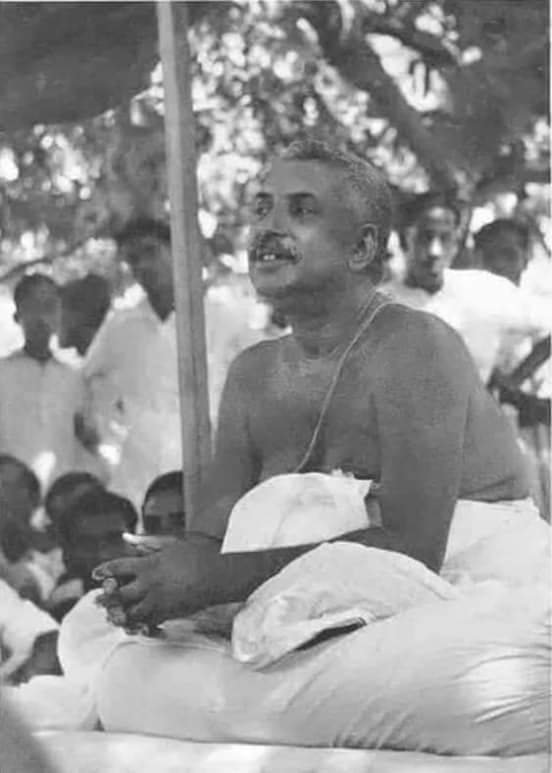
He did not teach any of this from a distance. Himaitpur was the village where he had been born, and he set out to show, there, how people can live and grow.
The school came first. Two local landholders gave five bighas of land beside the ashram, and the Tapovan school opened on it under a single teacher with a handful of boys. There was no school building and no hostel: a teacher, a few boys, and the ground. In time the boys and their teachers raised its walls with their own hands.
When the upper storey of the science centre stood half raised, six masons were brought from Dhaka, and some Tapovan teachers and their keenest boys began fetching and carrying for them. When the young men tried the tools, the masons said sharp things about it. Thakur had never liked to see his own people looking to another man’s hands for their work. He told them to watch the masons’ work with the closest attention and master it, and a few days later he bought them every tool of the trade. So the ashram had its own masons. The kitchen still served one meal a day; they ate it under the trees by the Padma, washed their plates in the river, and went back to work.
The bricks were made at night. In the great field below the embankment the men brought up the clay, and the women, saris tied tight at the waist, slapped it into moulds from dusk until dawn, thousands upon thousands of bricks, under lamps that burned all night. On the last night of one such stretch, a young wife from Mymensingh was late, and shy of arriving at an odd hour among so many people, she did not go at all. Among all those people, he had noticed. The next morning he asked her, “Why didn’t you go to cut bricks yesterday?” And then: “Never stay behind. Always go forward.”
Once he laid the foundation of a large tin-roofed house, and no one knew what it was for until press equipment arrived. Not one of the workers knew anything of printing. Machines broke down and type was spoiled, but his one wish was that they should become thoroughly skilled, and they did. In time the women of the ashram set almost all the type, besides their own housework.
A works for medicines began with two formulas of his own: an oil, and an ointment for the burns and cuts the new workshops were bringing, because there was no good medicine for them. “In the jungles of rural Bengal there are plants of extraordinary virtue beyond counting,” he used to say. He wanted the poor to be cured easily, and the country’s money to stay in the country.
One morning he went round the factory and the power-house works, then came back and sat down in his room, and the talk that followed was not of machines but of the mind and of light. The factory and the inner life were never at odds in him.
Dearest of all to him was the house of science, and it began with a sentence nobody believed. In the days when the ashram had not a paisa and the workers did not get two meals a day, he said to one of the brothers, laughing, “Try to raise funds for founding a science laboratory here.” Everyone took it for a jest. It was the most intense longing of his heart.
Years before the building stood, he sat one night at the ashram’s microscope and said: “Science seems to be leading man toward unity, in a vast plan — melting all the manyness and leading toward the One. The scientist is the rishi of this age.” Then the jungle was cleared. Begging for the money, he gathered one costly instrument after another, a projection microscope, an X-ray apparatus, a spectroscope, a galvanometer, and a great building rose by the river: the Vishwa Vigyan Kendra, the World Science Centre.
A school, a press, a workshop and a power-house, a works for medicines and a house of science, all of them grown up around one man who was loved, raised by people who had learned to do with their own hands what they had thought only others could do. This was what he meant by an ashrama, a place where one advances by labour. Dharma, the Ideal and the three practices were not a doctrine set beside that village. They were the village.